Rethinking how we prepare nurses to care for people with complex health and social needs: Results from a new evaluation of the Complex Care Certificate for Frontline Providers
Building the complex care field Education & training Workforce development

Complex care teams are operating in a rapidly changing healthcare environment where expectations are expanding, resources are often constrained, and patient needs extend well beyond clinical care. Despite this reality, our education systems, licensure exams, and training models remain largely rooted in acute care paradigms. Core competencies, such as understanding social drivers of health, navigating power dynamics, practicing harm reduction, and using motivational interviewing, are often treated as optional, rather than critical clinical skills. National leaders are calling for schools to strengthen their students’ understanding of health equity by integrating social drivers of health (SDOH), cultural competency, and other related content into the educational experience. Without this alignment in education, gaps in care will continue, and marginalized populations will continue to experience poor health outcomes.
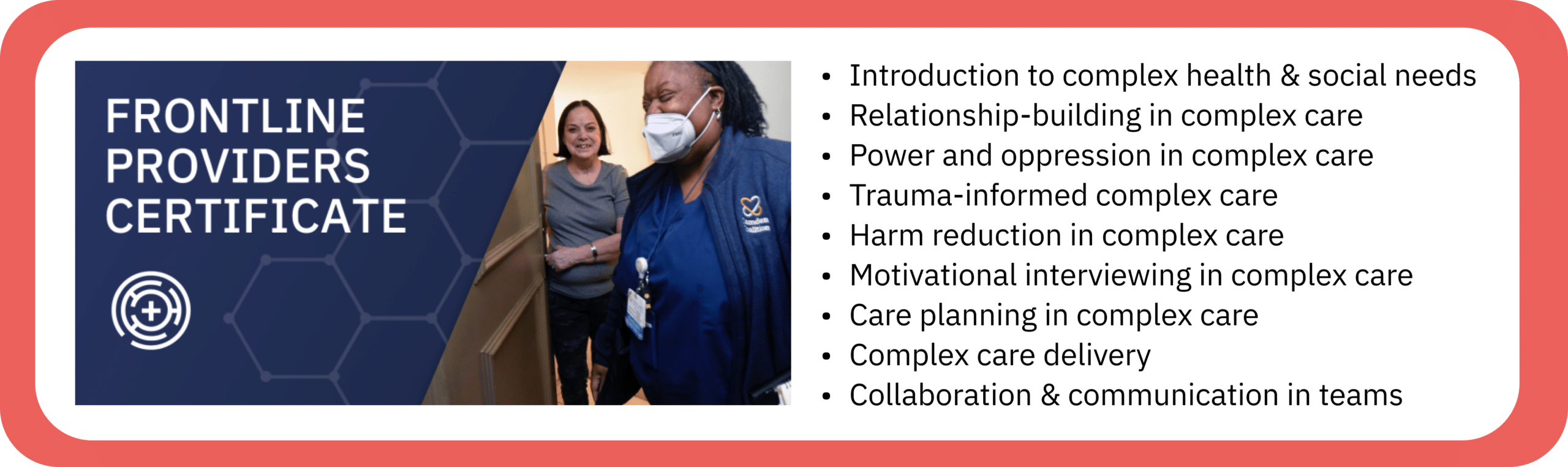
A new evaluation conducted by Kimberly McGuinness, DNP, of Rutgers-Camden School of Nursing has found that Camden Coalition’s Complex Care Certificate for Frontline Providers is an effective tool for addressing this gap by increasing clinicians’ confidence in practices needed to deliver person-centered care for people with complex health and social needs. The Complex Care Certificate for Frontline Providers is an online, self-paced training for frontline staff and others working across healthcare and social service disciplines in the complex care field. The curriculum delivers the knowledge, skills, and attitudes needed to provide complex care, including how to engage and build relationships with people with complex health and social needs, support people in sustainably achieving their goals, and work collaboratively within and across care teams.
The evaluation
Since its release in late 2023, over 1,000 people from diverse professional backgrounds have earned the Complex Care Certificate for Frontline Providers. Participants complete pre- and post-tests for each course, rating their confidence in multiple learning objectives using a 5-point Likert scale.
Focusing specifically on nurses, one of the authors (Kimberly McGuinness) analyzed these scores across all courses.
Every course demonstrated a statistically significant increase in learner confidence in relevant skills following completion. On average, participants began with moderate confidence (scores around 3.1–3.3) and finished near the high-confidence range (4.2–4.3). Confidence scores are a key metric as they measure self-efficacy, which research shows is a real and important outcome of training — it doesn’t just measure how people feel, but how capable they believe they are to apply what they’ve learned. Even small increases in confidence can be meaningful, especially in applied skills, because higher self-efficacy is linked to better performance, persistence, and success in real-world settings.
Notably, scores were less variable after the course than before. This means participants’ confidence levels became more consistent, suggesting the curriculum helped align understanding and skill development across the group.
Where confidence grew the most
Learners experienced the largest increase in confidence in motivational interviewing (from 3.1 pre-test average to 4.3 post-test average), reinforcing its value as a practical, patient-centered skill in which many nurses receive limited formal training. The course on power and oppression — which addresses implicit bias, cultural humility, and systemic inequities — also produced a substantial shift (from 3.2 pre-test average to 4.3 post-test average). These findings point to both a significant gap in knowledge and a readiness among nurses to engage with these critical, and often challenging, topics.
Implications for education and practice
Caring effectively for patients with complex health and social needs requires interprofessional teams to build authentic healing relationships, engage patients in meaningful goal setting, acknowledge power imbalances, and meet patients where they are.
To meet the demands of today’s healthcare environment, we must better train the workforce.
For nurses’ education and practice in particular, this evaluation indicates the need for several changes:
- Curriculum integration: Topics such as privilege and bias, harm reduction, and motivational interviewing are core to nursing and other professions who support people with complex needs. These topics should be embedded early and reinforced throughout education — not relegated to electives or continuing education.
- Licensure alignment: Until exams like the NCLEX (National Council Licensure Examination) reflect the realities of complex care, curricular change will remain slow.
- Continuing education: Health systems and other provider organizations should adopt structured complex care training as part of annual or onboarding education, not optional enrichment.
The Complex Care Certificate offers a scalable, evidence-informed model for preparing providers to meet the needs of the most vulnerable patients.
A final thought
Patients facing complexity are navigating systems that were never designed with them in mind – systems weakened further by disinvestment. When we equip nurses and interdisciplinary teams with the confidence and skills to address complexity, we do more than improve care. We honor healthcare’s core commitment to equity, advocacy, and human dignity.