Ecosystems 101
By Rebecca Koppel, Senior Program Manager for Field Building and Resources
Building the complex care field Strengthening ecosystems of care Quality improvement SDOH & health equity
Building the complex care field Strengthening ecosystems of care Data sharing Quality improvement Workforce development

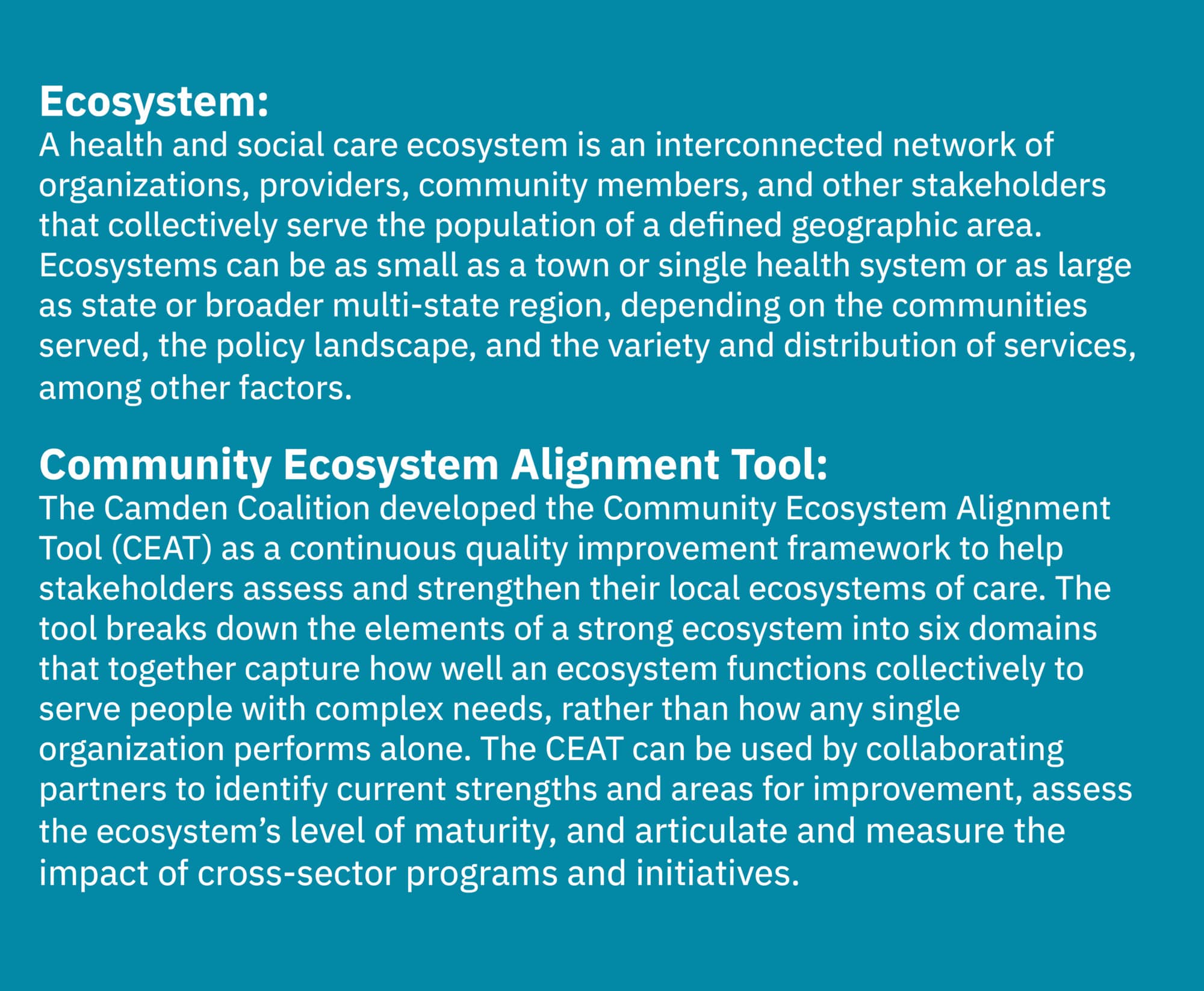
That question is at the heart of a new piece published today in Health Affairs Forefront. In “Closing the Alignment Gap: The Next Frontier for Whole-person Care,” Camden Coalition leaders and partners explore how Camden Coalition’s Community Ecosystem Alignment Tool (CEAT) is helping diverse stakeholders strengthen coordination across systems to better serve people with complex health and social needs. To mark the publication, we spoke with two of the authors, Camden Coalition President and CEO Kathleen Noonan and Senior Advisor Dr. Purva Rawal, about the origins of the tool, the challenges it was designed to address, and why improving alignment across organizations is the next big frontier.
Kathleen Noonan: The Camden Coalition created CEAT right after we finished our randomized control trial (RCT) with J-PAL North America at MIT. We had tested the Camden Core Model with a complex population, and we had some clients where we had done as much as we could do, and we still didn’t get the outcome we hoped for. Some of that was because we were dependent on other partners but, it wasn’t that they were failing, it was that the system wasn’t set up for us to work together.
The patients we were trying to help really required a lot of different partners — some of them in the health systems, some of them outside the health system. As we thought about that, we asked ourselves, “what does it actually take for partners to work together?” and why don’t we have any playbook or tools beyond just, “we all need to collaborate together to do this?”
Purva Rawal: One of the things we talk about in the paper is that the policy signal for where the health system is going is pretty clear: it’s accountable care and integrated care models. Right now, the focus is on payment and how we’re changing payment to facilitate whole-person care and how we want the care delivery system to change. Those are two really important pieces, but one of the hypotheses here is that there’s a mediating factor being overlooked. Change needs to happen within local provider ecosystems, not just within individual organizations, to make actual payment and care delivery work on the ground.
The gap that the tool is filling is pretty significant. It is helping us realize the potential of these models in a way we can’t right now because providers aren’t aligned on some of the core capabilities necessary for doing the work. The theory is that eventually, we’ll get to a point where we can see that when we strengthen how providers in an ecosystem work together, the ACOs and the health systems can deliver on the big picture outcomes they’re being measured on, like improving population health. We’ll also be able to see things like if there is a happier and less burnt-out workforce because they’re finding more efficient and satisfying ways of working together. And then there’s obviously the component related to costs. We hope to be able to see if [the tool helps] manage costs better because we’re more effectively connecting the health system to community-based organizations who can address people’s health-related social needs, which we know saves money.
Purva:The tools helps health systems and ACOs move upstream from individual interventions. Right now, we’re very focused on programs that address care transitions and introducing community health workers. These are really important components of how we’re using different ways of paying for care and actually changing the care delivery system, but I think that those interventions could be a lot more effective. Organizations and teams need concrete ways of working together on things like how they measure and share data, align on priorities, and address the different dimensions and components reflected in the tool.
Kathleen: An important insight we’ve had from our client work on the ground is that many of them report very positive point-in-time interactions with health and community-based providers. The frustration and where things really go south for many is the in-between. It’s about the lack of collaboration and the moments of “This clinician doesn’t know what this other clinician said,” or, “I was discharged and then my home care didn’t have access to information about my medication management or who to get in touch with.” We are a country with some very strong point-in-time healthcare and a lot of very smart and dedicated clinicians, but we have not invested in how it comes together. We really need to pay more attention to this because, from where we observe things, it is diluting the effectiveness of otherwise potentially effective healthcare interventions.
Purva: Kathleen, as you’re talking, it’s making me think about the journey of the clients that Camden serves and works with. For any Medicare beneficiary or dual-eligible beneficiary in an integrated care model, their journey is not siloed. They’re not experiencing their hospitalization and then saying, “Okay, well, now I’m going to switch gears and go work with my primary care doc. And once I’m done with that, I’m going to work with the CBO that’s helping me navigate behavioral health or housing support.” That’s not how they experience it. It’s continuous — they’re on a journey and that journey is constantly shifting and changing. And if you think about it that way and put yourself in that individual’s seat, you have to have all of those different components talking together. You need all of these people and really smart and dedicated clinicians, not only doing what they do, but doing it together in a way that follows the patient through all of those different transitions. Something we talk about in the article is that we haven’t really paid attention to the how of getting people to work together and making it feel possible. It can feel so overwhelming when we’re talking about all of these big issues and saying, “We need hospitals to be talking to primary care, but we also need them to be working with social service agencies and behavioral health providers.” In a system that’s really complex, one of the most compelling things about the tool is that it breaks it down into something manageable and achievable.
Purva: When Kathleen and I first spoke last fall, we sat down and she started walking me through the tool and light bulbs started to go off. Like look, you’ve set policy, you changed payment, but as I said earlier, we’re not always seeing the results we want to see.
As a psychologist and someone who has spent so much of my time in the policy world, I felt like, well, here’s something we can do outside of policy since the policy has been set. Now we need to help people on the ground actually achieve what that policy goal is. That’s just not something you can do in government or at CMS because you’re just too far away from what’s happening on the ground. So to me, this was an amazing opportunity to get closer to what’s happening on the ground and connect the dots across policy and actual implementation.
Kathleen Noonan, JD, is President & CEO of the Camden Coalition. Previously, Kathleen spent 10 years working at the Children’s Hospital of Philadelphia (CHOP), where she co-founded PolicyLab at CHOP to connect clinical research with real-world health policy priorities, and served as Associate Vice President, managing the board and other special projects for the CEO. She continues to serve as adjunct faculty in the Division of Pediatrics at the University of Pennsylvania Perelman School of Medicine and as mediator in numerous public-impact litigations concerning health, behavioral health, and human service issues.
Purva Rawal, PhD
PhD most recently served as Chief Strategy Officer at the CMS Innovation Center before joining Camden Coalition as a Senior Advisor. She is also an Advisor at the Duke Margolis Institute for Health Policy, is the Co-Director of the Leading Transformation for Value-Based Health Care program at Johns Hopkins University, and is a Managing Principal at Health Transformation Strategies. Dr. Rawal is an internationally recognized leader in value-based care and system transformation, with over two decades of experience spanning government, academia, and the private sector. She brings her experience in behavioral health, child welfare, Medicare and Medicaid policy, and health equity to inform the development, testing, and scaling of new tools and approaches that help align health, social, and community-based services systems around the needs of communities and individuals.


By Rebecca Koppel, Senior Program Manager for Field Building and Resources
Building the complex care field Strengthening ecosystems of care Quality improvement SDOH & health equity
Building the complex care field Strengthening ecosystems of care Education & training Measurement & evaluation Quality improvement SDOH & health equity
Care management & redesign Strengthening ecosystems of care Quality improvement